Streaming sends live output from a model over a server-sent event (SSE) stream. It works with any Python object that implements the iterator or generator protocol. The generator/iterator must yield data, which is sent downstream via the text/event-stream Content-Type. Data can be sent in JSON format and decoded on the client side. A minimal example:
import time

def run(upper_range: int):
    for i in range(upper_range):
        yield f"Number {i} "
        time.sleep(1)
Deploy this snippet and call the endpoint. SSE events appear progressively, one per second:
curl -X POST https://api.aws.us-east-1.cerebrium.ai/v4/<YOUR-PROJECT-ID>/2-streaming-endpoint/run \
       -H 'Content-Type: application/json'\
       -H 'Accept: text/event-stream\
       -H 'Authorization: Bearer <YOUR-JWT-TOKEN>\
       --data '{"upper_range": 3}'
This should output:
HTTP/1.1 200 OK
cache-control: no-cache
content-encoding: gzip
content-type: text/event-stream; charset=utf-8
date: Tue, 28 May 2024 21:12:46 GMT
server: envoy
transfer-encoding: chunked
vary: Accept-Encoding
x-envoy-upstream-service-time: 198995
x-request-id: e6b55132-32af-96d7-a064-8915c4a42452

data: Number 0
...
The remaining data streams in every second:
...
data: Number 1

data: Number 2
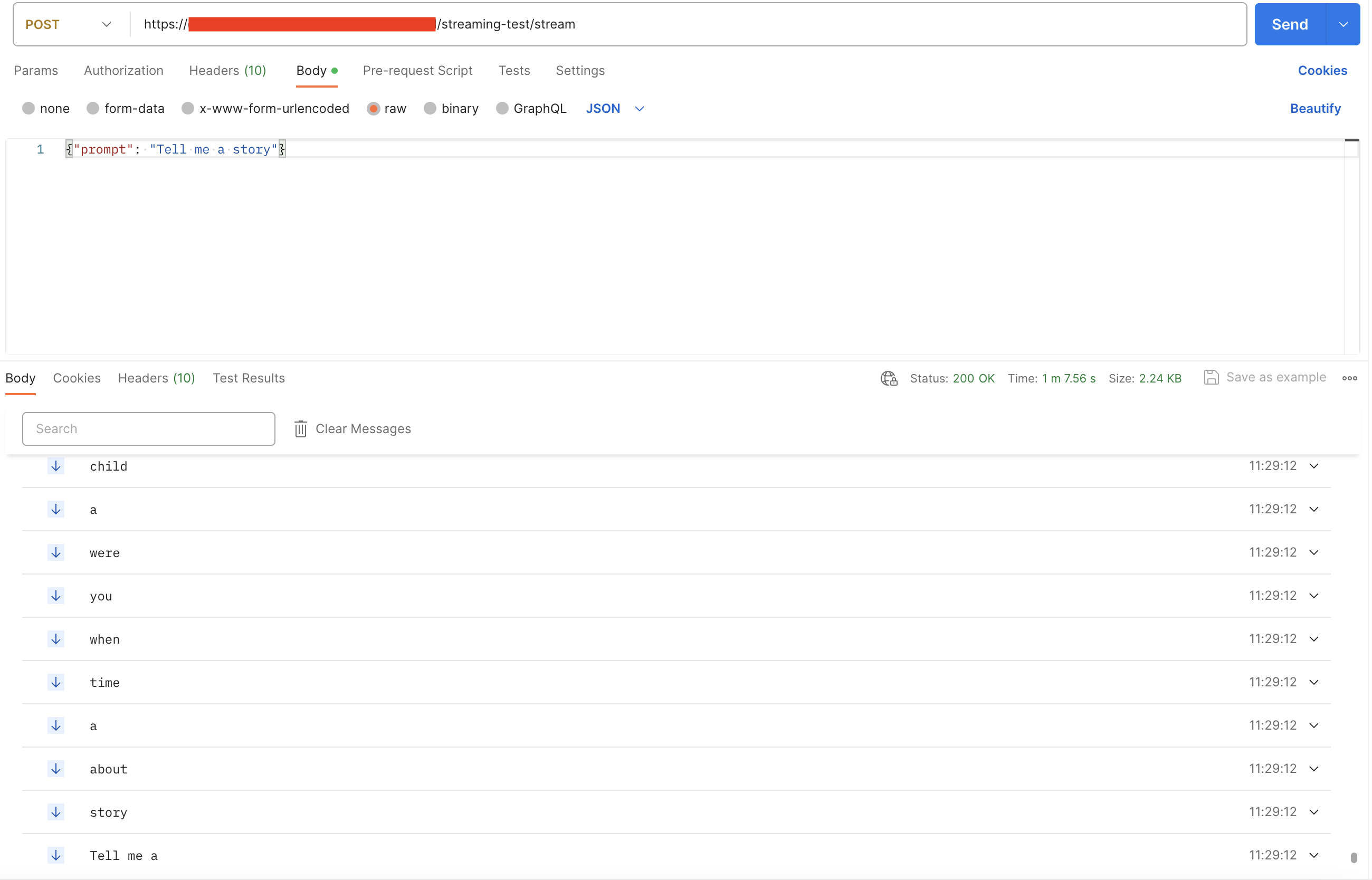
Postman also supports SSE streams natively. Streaming For a Falcon-7B streaming example, see the streaming endpoint example.